BJJ wholesale buying guide · Updated July 30, 2026
BJJ Wholesale Gear Supplier Guide for Academies and Private-Label Brands
How to compare rashguards, no-gi sets, gis, sizing, samples, branding, quality control, reorders, and total landed cost before placing a bulk order.
Why BJJ wholesale buying is different from ordinary activewear
A wholesale BJJ order has to solve several problems at once. The gear must perform during grappling, represent the academy or brand accurately, fit a mixed group of athletes, withstand repeat washing, and remain consistent when you reorder months later. That makes supplier selection more technical than ordering standard promotional clothing.
For an academy, the order may become an official uniform program, a member-retention tool, and a retail revenue stream. For a private-label fightwear brand, it becomes inventory, customer reviews, product reputation, and future cash flow. A weak sample or vague specification can therefore affect far more than one shipment.
The best supplier is not simply the factory with the lowest quote. It is the manufacturing partner that can translate your requirements into a repeatable specification and explain the path from artwork approval through bulk packing.
1. Decide which BJJ wholesale model you need
“Wholesale” describes several buying models. Clarifying yours first prevents comparisons between quotations that do not cover the same service.
Stock wholesale
Buy existing products at a trade price for resale. It can be fast, but customization, availability, and long-term product control may be limited.
Custom academy gear
Add academy colors, logos, sponsors, member names, or event artwork to an established product or base pattern.
OEM and private label
Manufacture to your approved specifications, artwork, labels, packaging, and product identity with greater control over the result.
ODM-style development
Adapt an existing design or manufacturing concept to reduce development work while confirming permitted changes and ownership in writing.
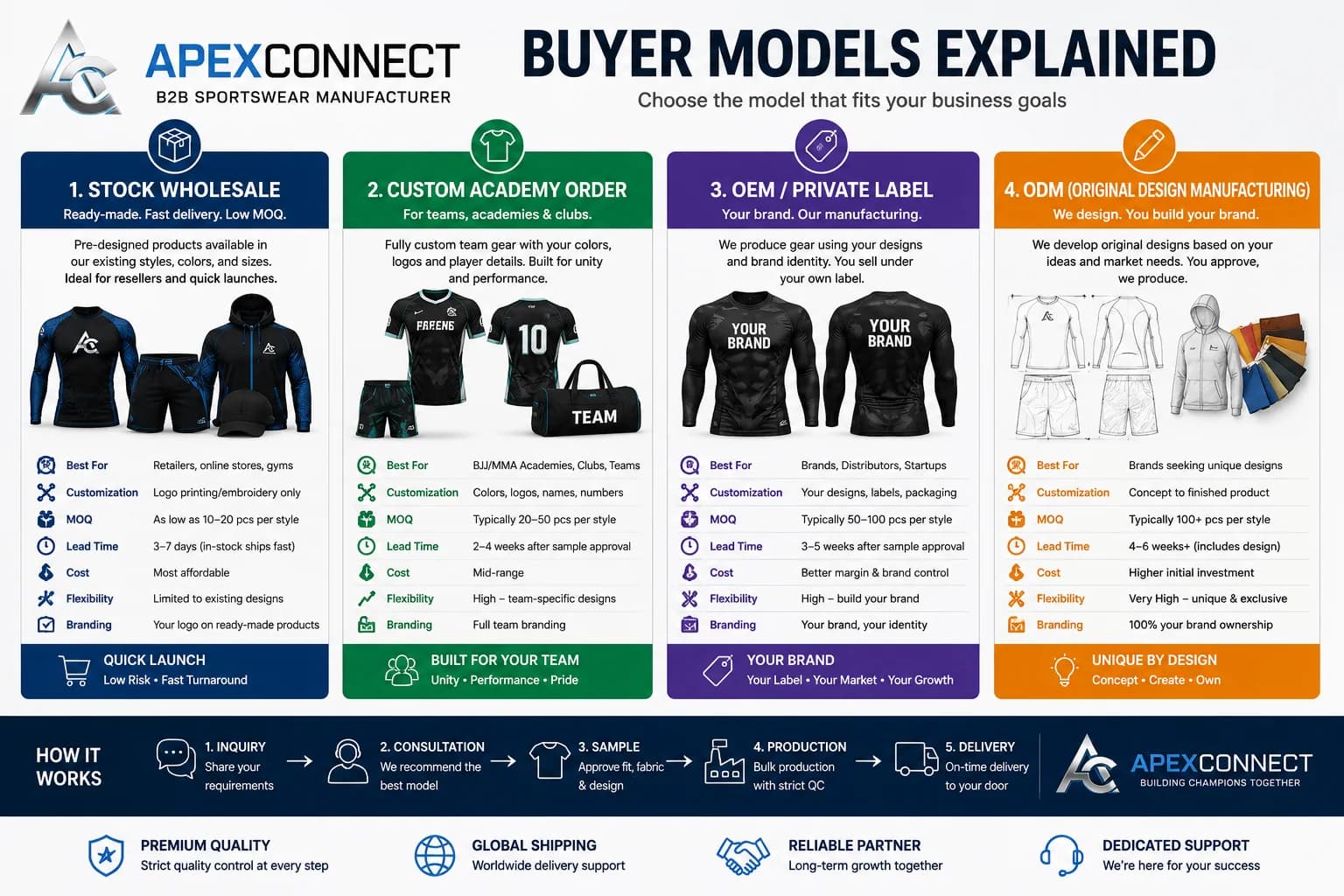
Before requesting prices, write a one-sentence buying brief: “We are an academy ordering custom team gear,” “We are a retailer buying stock wholesale,” or “We are building a private-label BJJ collection.” That sentence gives every supplier the same starting point.
2. Build a focused first product range
Launching too many items, colors, and fits in the first order increases sample work, size complexity, artwork revisions, and inventory risk. A focused capsule is easier to approve, market, and reorder.
No-gi essentials
- Short- or long-sleeve rashguards
- Fight or grappling shorts
- Spats and compression leggings
- Women’s and youth fits when needed
Gi program
- Gi jacket and trousers as a size set
- Approved patch or embroidery positions
- Belts and supporting accessories
- Separate training and competition specs
Off-mat merchandise
- T-shirts, hoodies, and joggers
- Gym bags, caps, and event gear
- Retail-ready packaging
- Member or launch bundles
One rashguard, one matching short, and one off-mat item can be enough for a practical first launch. Expand the range after sizing, artwork, customer response, and reorder demand are proven.
3. How to evaluate a rashguard supplier
Rashguards should not be treated like printed T-shirts. Compression, stretch, seam comfort, torso length, sleeve shape, and artwork placement determine whether a garment performs during grappling.
Fabric, stretch, and opacity
Ask for the proposed fabric specification, stretch direction, opacity, hand feel, and intended use. Materials with similar fiber descriptions can behave differently under movement. Test whether the sample becomes transparent, restrictive, or loose when stretched.
Pattern and compression fit
A size label is not a specification. Confirm chest, waist, body length, sleeve length, cuff, collar, and hem measurements. The garment should provide movement without riding up, restricting the shoulders, or becoming loose around the torso.
Seams and comfort
Review seam type, placement, thread stretch, reinforcement, underarm construction, and collar finishing. Wear-test the sample for chafing, seam tension, and mobility rather than approving construction only by appearance.
Sublimation, labels, and retail identity
For sublimated products, confirm the final artwork file, color references, print zones, sponsor placements, ranked-color areas, and alignment across panels. Private-label buyers should also specify neck labels, size and care labels, hang tags, barcodes, polybags, and carton marks. Explore our transactional custom rash guard manufacturing page when you are ready to discuss a product.
Competition requirements must be checked before production
Do not rely on “competition compliant” as a general claim. Verify the current official rules for the governing body or event, then translate them into exact garment colors, ranked-color areas, length, closures, and construction decisions for the approved sample.
4. Approve a physical sample like a buyer
A digital mockup confirms visual direction; it cannot prove fit, stretch recovery, construction, print alignment, opacity, or comfort. Review the physical sample systematically and document the decision before bulk production.
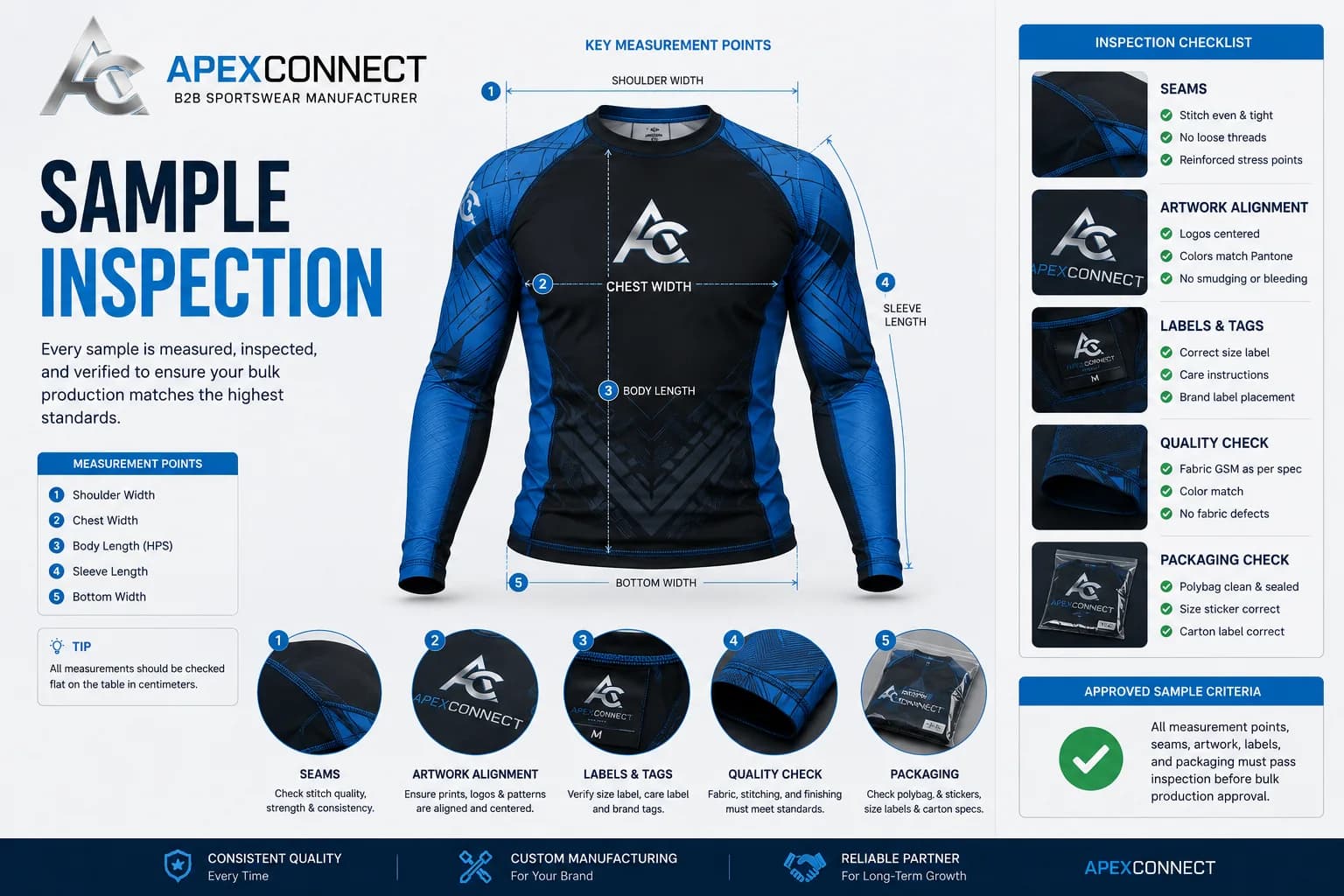
- Compare critical measurements with the approved size chart.
- Test shoulder movement, torso coverage, sleeves, and waistband interaction.
- Inspect seam flatness, skipped stitches, loose threads, and stress points.
- Stretch printed areas to check opacity, color, and panel alignment.
- Confirm every logo, sponsor name, spelling, and safe print zone.
- Wash the sample using the proposed care instructions and inspect it again.
- Check size labels, care labels, tags, packaging, and barcode placement.
- Record approved changes and retain photos or an approval sample.
The approved sample becomes the control reference. A later change to fabric, trim, seam, label, packaging, or production method should be disclosed and approved instead of being treated as interchangeable.
Review the custom apparel sampling process5. Questions that reveal a repeatable supplier process
- Which product details become fixed after sample approval?
- How are fabric, colors, artwork, measurements, labels, and packaging recorded?
- What measurement tolerance is used, and how is it checked?
- Can the same pattern and colors be reproduced for a reorder?
- How are bulk units compared with the approved sample?
- What happens if an approved material or trim becomes unavailable?
- Who owns the artwork, print files, labels, and custom patterns?
- How are defects, shortages, and replacements handled?
- Which shipping terms are included, and who is responsible for duties and customs?
Specific answers are more useful than impressive adjectives. A supplier that documents approvals and explains variables is easier to evaluate than one that promises “premium quality” without defining what will be controlled.
6. Compare total landed cost, not only unit price
A low unit quote may become expensive after development, packaging, freight, duties, payment fees, rejected units, or urgent replacements. Compare every supplier using the same scope and calculate the cost of receiving usable products at your location.
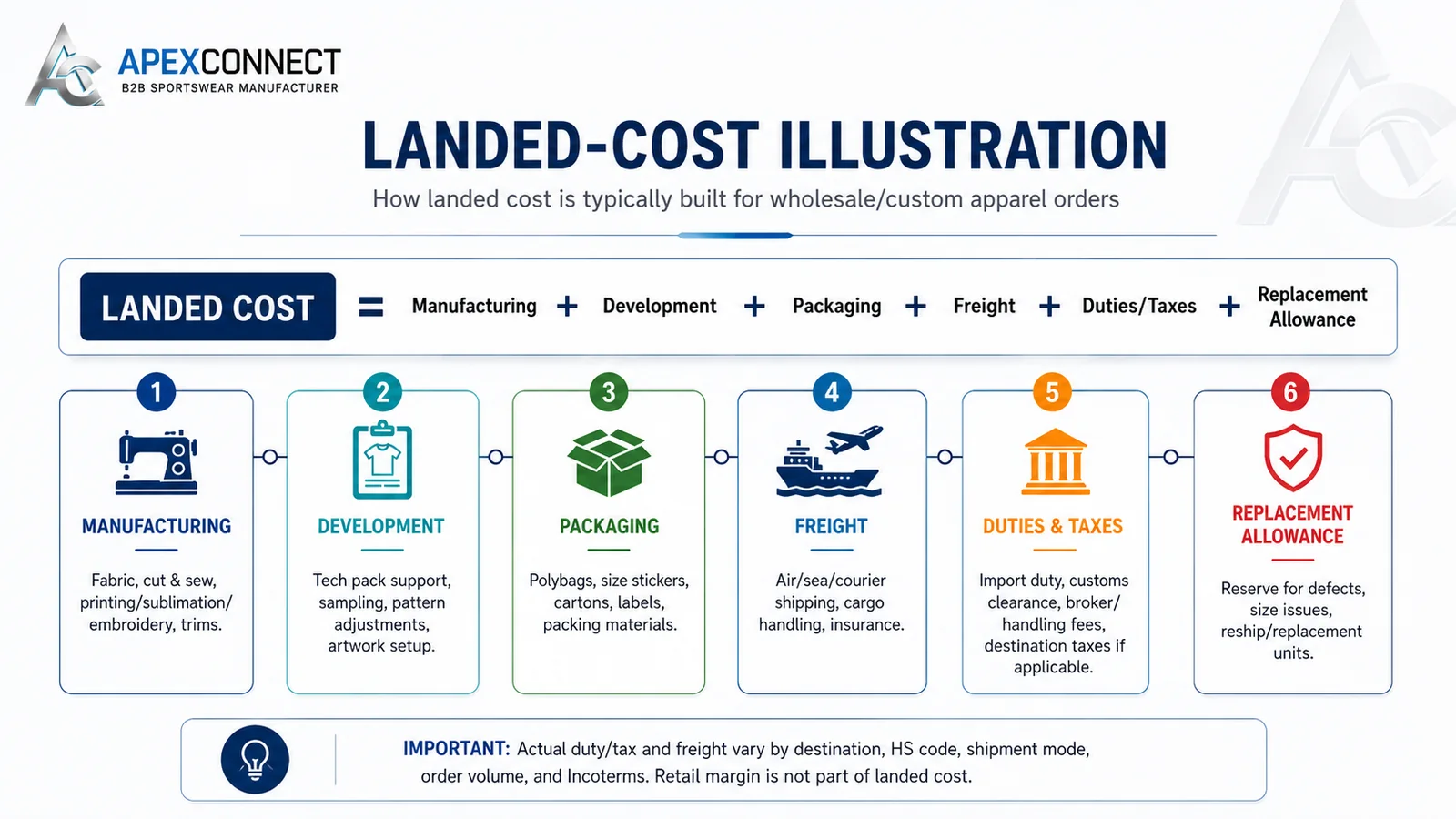
Include manufacturing, sample and development charges, artwork or setup, labels, packaging, freight, duties, taxes, brokerage, payment fees, inspection, replacement allowance, warehousing, and expected reorder costs. Never compare a factory-only price with a delivered quotation as if they represent equal service.
Read the detailed MOQ, sampling, and landed-cost guide7. Academy buyers and private-label brands need different controls
| Decision area | Academy or gym | Private-label brand |
|---|---|---|
| Primary goal | Team identity, member fit, repeat ordering | Distinct product identity, margin, brand control |
| Size planning | Mixed adult/youth roster and replacements | Forecast by size, fit, and sales channel |
| Artwork | Academy logo, rank colors, sponsors | Collection identity, SKU system, packaging |
| Order structure | Team bundles, preorders, replacement sizes | Inventory depth, launch calendar, replenishment |
| Approval focus | Comfort, uniformity, reorder simplicity | Differentiation, QC, labeling, presentation |
8. A practical first-order workflow
- 1Define the buyer type, intended use, product list, target market, and launch date.
- 2Prepare artwork, reference products, size requirements, and branding details.
- 3Request comparable quotations using one specification and destination.
- 4Confirm materials, patterns, construction, print zones, labels, packaging, and shipping terms.
- 5Approve a digital mockup, then order a physical sample.
- 6Measure, wear-test, wash-test, inspect, and document the sample.
- 7Approve the final specification and bulk production in writing.
- 8Review appropriate production evidence and inspect packed goods against the approval reference.
- 9Save the final artwork, size chart, materials, labels, packaging, and changes as a reorder file.
9. Common BJJ wholesale mistakes
Choosing only by price
A lower quote is not a saving when sizing, colors, seams, or labels cannot be reproduced.
Approving from a mockup
A mockup cannot prove stretch, fit, seam comfort, opacity, or wash behavior.
Using vague size labels
Small, medium, and large are not specifications. Use measurements and grading.
Assuming every rashguard fabric is equivalent
Test the actual proposed material under stretch and washing.
Ignoring competition details
Verify current rules and translate them into exact garment and artwork decisions.
Launching too many SKUs
A focused capsule is easier to approve, sell, and reorder.
Leaving shipping terms unclear
Confirm freight, customs, duties, destination, and delivery basis in writing.
Publishing unsupported claims
Do not claim exact materials, certifications, timelines, or performance without supporting specifications.
10. What to send for an accurate BJJ wholesale quote

Include your buyer type; product list; quantity by design and size; adult, women’s, youth, or unisex fit; intended use; artwork; preferred material and construction; rank-color requirements; labels and packaging; destination; delivery window; and whether you need a mockup, physical sample, or existing base-product option.
Better quotations start with better briefs. When product, quantity, size mix, branding, destination, and approval requirements are clear, suppliers can quote on equal terms and you can reduce revisions.
A legally registered manufacturing partner
The Apex Connect is operated by THE APEX CONNECT (SMC-PRIVATE) LIMITED, incorporated in Pakistan under the Companies Act, 2017. Company-level registration information is published for buyer due diligence; personal identity, residential, banking, and account documents remain private.
- SECP corporate ID
- 0308258
- FBR registration / NTN
- H503706
Taxpayer status record reflects the official check dated December 2, 2025. Buyers should independently verify current status during vendor onboarding.
How The Apex Connect supports BJJ and no-gi sourcing
The Apex Connect supports quote-based OEM/ODM manufacturing for custom sportswear and combat-sports apparel, including rashguards and no-gi products for academies, gyms, teams, and private-label buyers. The sample-first workflow covers artwork, material and fit decisions, print zones, labels, packaging, and bulk quality checks.
Frequently asked questions
What does BJJ wholesale mean?
BJJ wholesale can mean buying existing gear for resale, ordering custom academy uniforms, or manufacturing private-label products. Confirm the model before comparing quotations.
Should I order a sample before bulk production?
Yes. A physical sample lets you check measurements, fit, movement, seam comfort, artwork, labels, packaging, and wash behavior before approving a larger order.
How do I compare rashguard suppliers?
Compare the proposed fabric, pattern, size chart, construction, artwork process, sample approval, quality checks, reorder controls, shipping terms, and total landed cost—not unit price alone.
How many pieces do I need to order?
Minimum quantities vary by product, design, size mix, and customization. Ask for a written quote explaining whether minimums apply per style, color, design, or total order.
Can rashguards, shorts, and spats be combined in one order?
Sometimes. Suppliers may allow mixed sizes or products, while others calculate minimums separately. Confirm the rule before building the collection.
How can I make sure gear follows competition rules?
Check the current rules of the relevant event or governing body, then validate colors, rank areas, length, closures, pockets, and hard components against the physical sample.
What affects wholesale BJJ gear pricing?
Product type, fabric, construction, print method, quantity, size range, labels, packaging, development, freight, destination, and delivery terms can all affect final cost.
What should be saved for reorders?
Keep approved artwork, measurements, pattern reference, fabric, color references, labels, packaging, carton marks, and written change history.
Final takeaway
A reliable BJJ wholesale program is built on specification control, not slogans. Define the buying model, start with a focused range, approve a physical sample, document the product, compare total landed cost, and save a complete reorder file. Those steps improve the chance of receiving gear that fits, performs, represents your academy or brand correctly, and can be reproduced when demand grows.